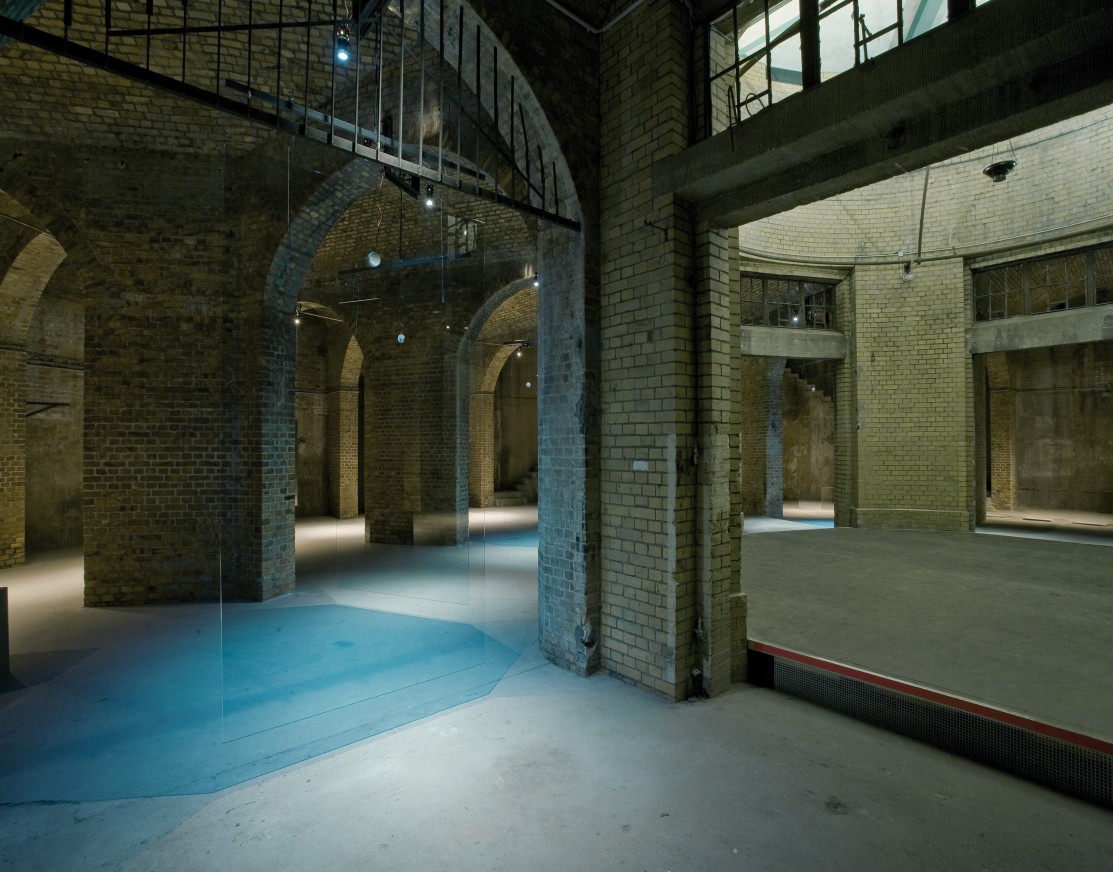
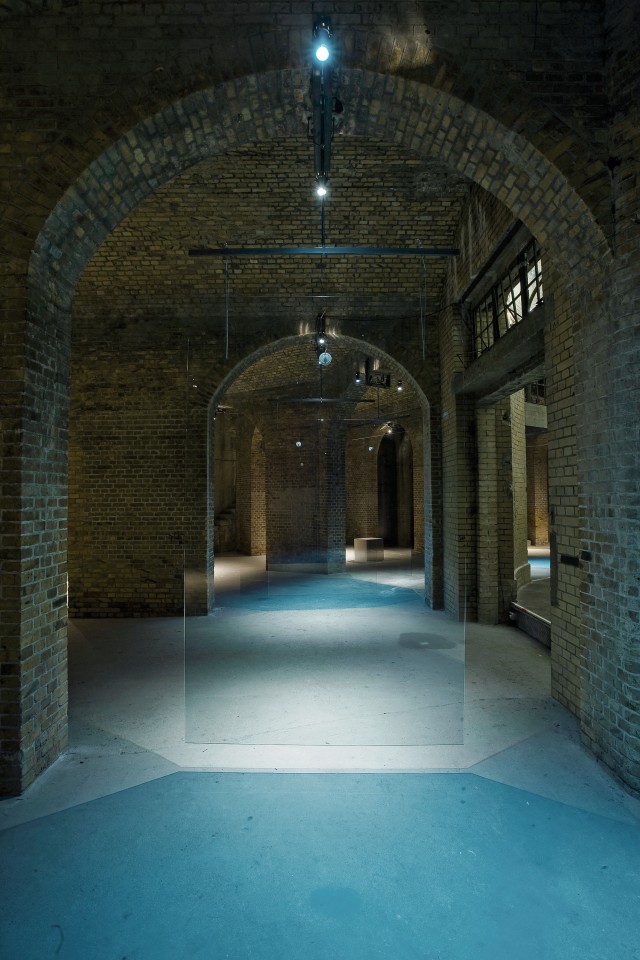
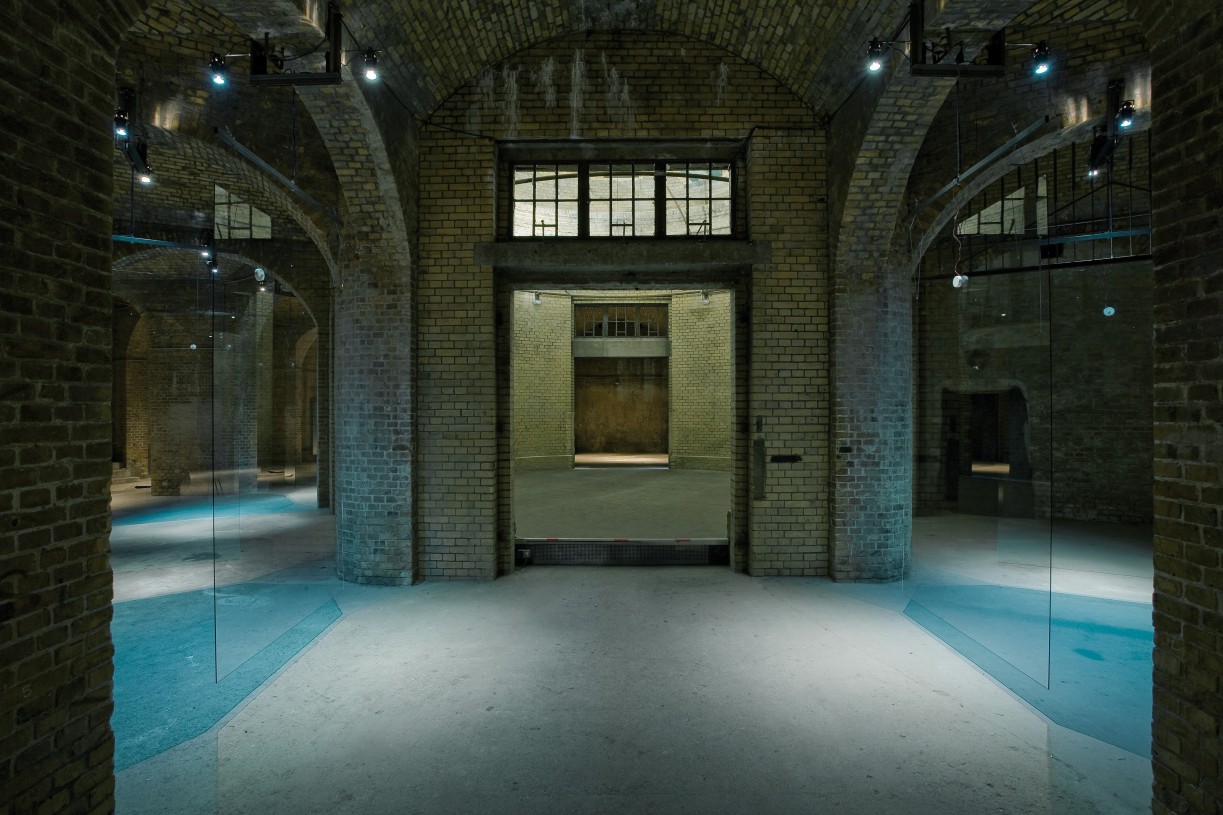
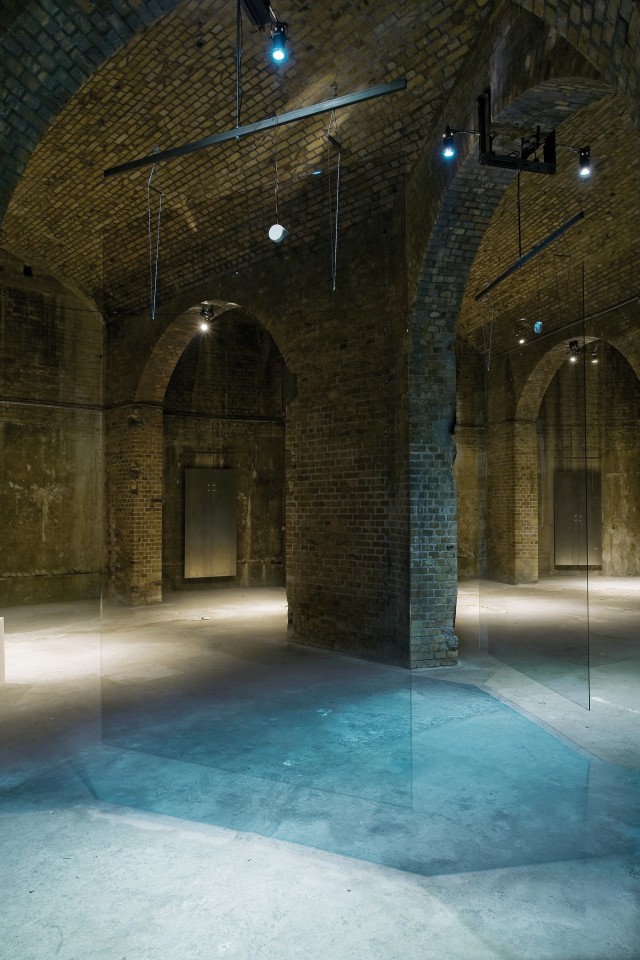
The exhibition space in all its aspects — foundation / proportion / volume / acoustic — serves as the initial point that forms the variable. The implemented materials — glass, metal and transducers – form the constant. The site-specific aspect of the work is maintained throughout. Similar to Gordon Matta-Clark’s cuts through existing buildings, here “acoustic cuts” attempt to create new perspectives. Each surface object serves as a loudspeaker, and simultaneously as shaped, space-creating element. Through the connection between given architecture and architectonic intervention which, at the same time, is a played, sounding object, the separation between visual and audio composition is revoked. A unification between space (architecture), materiality (surface objects) and sound is established. Small Water Reservoir can both be experienced through the glass surfaces perceived as acoustic subspaces and also in its entirety as a resonating, specific sound space. The acoustic representation of the exterior space — a loudspeaker, indirectly emitting upwards against the flat concrete ceiling at the centre of the Small Water Reservoir, projecting hour long recordings of the surrounding — opens the center space and establishes a connection to its environment. The sound installation Resonant Cuts builds on musical material recorded on location in a one-day concert installation and recordings from the preceding rehearsals. Initially, through the derivation process, the musicians, their instruments, and the room itself stand centre stage. In the following sound installation the materials used become reduced: The instruments disappear in their entirety. Their place take surfaces/objects made of glass and metal played through transducers with the recordings generated beforehand. Resonating in their entire dimensions, these surface objects function as complex sound filters because of their different materiality and structure. (Michael Moser)
-> Bandcamp
-> Edition RZ
-> singuhr
Kleine Wasserspeicher in Berlin’s Prenzlauer Berg, with its 1200 square meters and high vaulted ceiling, is generally considered a difficult space. It is dark and cold, complex and expansive. But most importantly, it subjects sound to a powerful reverberation. It is impossible to simply ignore it or harness it. Moser not only confronted these difficult conditions, but declared them the subject of his installation by making certain frequencies of the space as defined by its
architectural characteristics a central issue. The space, Michael Moser explains, is part of the instrument that he plays. The Austrian cellist, born in Graz in 1959, has systematically and artfully explored acoustic space in recent years. These explorations reached their apex with the sound installation Resonant Cuts, which could be experienced in the summer of 2008 at the singuhr - hoergalerie berlin at Kleiner Wasserspeicher.
Resonant Cuts begins with an initiation. Five musicians scan the architecture acoustically, feeding the space with individual sounds and sound figures, with impulses and quiet sustained tones. The sounds fan out from the center into the individual chambers of the underground reservoir: in a sense, each musician occupies a corridor that he auscultates and musically fills. The space absorbs these tones and lends them a second, reflected life, for Moser uses during this phase a live electronic device that filters and brings to the forefront the space’s own requencies. The musician plays a sound. By microphone, the sound is recorded and then played back via loudspeaker. The loudspeaker playback is again recorded, then played back, recorded and played back. The space gradually changes the sound, scraping away spectra from the frequency range and amplifying certain overtones. The sound and its reverberation increasingly overlap, until finally a bell-like sound cloud emerges and the original tone disappears. What remains is the space itself that manifests itself acoustically in this sound, a technique that Alvin Lucier explored in his 1969 piece I Am Sitting in a Room. Unlike Lucier, Moser lets the musicians influence the sound by requiring them to constantly add new material to this process of spatial derivation.
In the weeks that follow, the recordings of this “concert in installation” become the material of the installation, along with the passages recorded in the same space. Individual sounds and sonic moments are distributed across glass and metal membranes and moved through the space with the help of a complex computer algorithm. Both the motion and placement on the individual plates as well as the series of sound files are determined by this algorithm. As a result, various constellations of complex, mobile sound spaces emerge between the outer ring of metal plates and the inner ring of glass plates.
The space itself remains almost empty. Moser divided the high stone arches that structure the round space with large glass plates, placing metal plates on the outside walls, resulting in chambers that are optically and acoustically permeable. This is how the title of the work should be understood: in referring to the resonances of the space and the cuts with which the glassplates structure the space, “resonant cuts” emerge. The freely pulsating glass and metal plates are at the same time bearers of sound—a visual intervention and a membrane. For Moser does not work with loudspeakers, but with transducers, which transfer the acoustic wave to a random material. The glass plates vibrate almost unnoticeably and place the sound in the space almost as if it had no source. Unlike loudspeaker sound, which generates a sonic field that can be clearly located, lending the sound not only a direction, but also a dynamic presence, the resonant plate grants the sound an unusual spatial impression. Only by placing your ear very close to the plates can the acoustic vibration be verified, a vibration that is even barely noticeable to our sense of touch. In so doing, the hanging and the drillings become veritable acoustic parameters. In particular, the position of the transducer on the glass plate must be chosen for its physical aspects, for the sound changes with each new position on the glass. Moser here could turn to the experiments of the physicist Ernst Florens Friedrich Chladni, who explored the resonance and reverberation behavior of plates in the eighteenth century, in order to calculate how the drilling of hanging points and placement of transducers on the plates could be arranged in such a way as to mute the vibration of the glass as little as possible.
It lies in the nature of installative work as such to liberate music from the domination of the temporal and thus to abolish the dubious distinction once proposed by Johann Gottfried Herder between the spatial and the temporal arts. And while the installation in Moser’s case is naturally also temporal, for the piece develops in a musical sense in a quite emphatic sense of the term, the relative sourcelessness of the sound highlights the spatial aspect. The sound wanders through the space and is simultaneously, like a wall or a column, also part of the architecture in which the beholder and listener move. Moser works with clear, simple materials: he opposes the bricked walls of the space with glass and metal. The relationship of height to width corresponds to the balanced proportion of the golden ratio. The glass plates with their clear cuts mark a dramatic break in the arch-shaped openings of the circularly arranged vaulted ceiling, while in their transparency and permeability they seem to open up the space. Between the view through the glass, the glass itself, and the reflection of the beholder, a multiply refracted spatial impression emerges.
Naturally, the quality of the sounds themselves also contributes to this impression. The five participating instrumentalists, who, like Moser himself, are at home in the realm of new music and/or free improvisation, played sonic explorations enriched with noise. Moser developed a voice for each musician, and more or less precisely notated his ideas. This means that he does not leave everything to chance, but indeed provides individual parameters like pitch level or a certain sound quality, a diastemic course or a duration exact to the second, but does not specify the sound event to the very last detail. There are various reasons for this non-specification. On the one hand, the sounds in Resonant Cuts are personified. That is, not just anybody plays the trumpet, but Axel Dörner, not just anybody is playing bass, but Werner Dafeldecker, not just some percussionist or contrabass clarinet player, but Burkhard Beins, Martin Brandlmayr, and Theo Nabicht. The material bears decidedly personal traits, the sounds are in a sense “authorized.”
The conviction that sound is such a personal matter, and thus difficult to mediate or communicate, is one of the aesthetic premises of free improvisation, which above all forefronts the details of sound composition. If on the one hand the empty spaces of notation, the non-specification of the parameters, are abolished by the signature of the instrumentalists, then on the other hand it is important that Moser opens a corridor for the musicians in the framework of which they can react to their acoustic surroundings, above all the sound characteristics of the space, as part of the work concept of Resonant Cuts. In other words, the relative imprecision of the notation leads Moser to a result that is perhaps not foreseen in every detail, but very pointed and exact in its sonic impact.
Another of the aesthetic premises of free improvisation is that musical links are no longer primarily sought on the level of the parameters usually notated. The individualization of sound moments, the concentration on movements in sound, on components of noise and the supposed coincidences of generating sound provide an essential contribution to the sound image of the installation. This shift of interest in terms of sound has quite fittingly been termed “acoustic microscopy.” Musicians expand the palette of timbres by applying the techniques they have developed with their instrument over the years and complementing them with the help of electroacoustic devices. This also includes the measured tempo of the piece, which provides the musician and the listener a chance to penetrate this displaced sound horizon and allows the details of the spatial acoustic to develop. The musical course of the installation is counterpointed by an occasional break, a colorful swoosh that washes away what has sounded before, as if to “wipe clean” the glass membrane, as Moser puts it.
Alongside this poetological aspect, we should not overlook the music’s poetic aspect. Historical necessities and acoustic laws should not conceal the fact that Resonant Cuts is also a lyrical piece, in which a serenity that approaches melancholy develops a dark, matte aura, an abstract chiaroscuro where contrasts between light and dark serve to amplify and dramatize the spatial, as in the painting of the Renaissance. The reductionist moment of free improvisation has often been interpreted as a reaction to the flood of information in modern societies, setting a focused and tense attitude in contrast to the superficiality of everyday life. Against this backdrop as well, Resonant Cuts can be heard as a site of consecration and contemplation.
This sensitivity for space and its acoustics in Moser’s music is closely linked to his improvisational work. In Vienna during the 1990s, musicians of all genres abandoned secure terrain. Established rock musicians like Christian Fennesz, Christof Kurzmann, and Peter Rehberg discovered the laptop as an instrument and abstraction as an aesthetic quality. Instrumentalists with a classical and jazz musical background in turn overcame traditional forms of playing to take a moment of freedom from jazz and the conceptual from the avant-garde, transferring it to their own non-academic and non-dogmatic form of musicianship.
In this climate of transformation and new beginnings, after studying architecture and music, in 1993 Moser founded Ensemble Polwechsel, along with bassist Werner Dafeldecker, trombonist Radu Malfatti, and guitarist Burkhard Stangl. Polwechsel quickly advanced to become an important proponent of the then new genre between conceptual art and reduction, between improvisation and erratic sound exploration. Moser was lastingly influenced as soloist by this change. As a cellist, he is also an exception because he has found a sound that does not rely primarily on virtuosity and luxurious sumptuousness, but listens for the margins of the instrument. Many composers treasure this very element of his playing: Peter Ablinger, Bernhard Lang, Michael Maierhof, Klaus Lang, Phill Niblock, Pauline Oliveros, and many others have thus sought out collaboration with him.
Today, Polwechsel, with Dafeldecker and Moser as remaining founding members, still works under these prerequisites: with the group dynamic of a rock or jazz band, the sonic imagination of a composer ensemble, and the conceptual approach of fine art. Over the years, Moser has increasingly excelled as a composer for Polwechsel. Both the 2006 CD Archives of the North as well as the 2009 CD with John Tilbury contain pieces conceived and developed by Moser, including Datum Cut, in which he for the first time worked with the aforementioned “feedback” of Lucierian provenance. Here too, Moser looks for other, unusual parameters to shape music and to lend his sounds a new meaning. Typical is the score for Site and Setting from 2005, which fixes temporal sections and lends them qualities, “one note OR one sound,” or “one model OR one action”. A sound level is described with the words “notes, longer durations, stable tones with small <,” another with "fragmented tones, like irregular tremolo or repetitions.” The result is a peacefully moving, hesitantly developing sonic action of delicate beauty.
Polwechsel’s new, unconventional approach necessarily raised several questions. How do I react to what I hear? How do I relate to space as an improvising musician? The space and supposed “natural” sound of an instrument become as a consequence a precarious event in need of aesthetic reflection. The amplification of spatial resonance that Moser undertakes in Resonant Cuts is an answer to this question.
Even if the cello is still central to his thinking in that the string instrument is the site where questions surface and answers are sketched, Moser has expanded his horizon in recent years beyond his instrument. In so doing, the sound installation has become a vanishing point of his work, because he can bring together sound and space beyond the architectural guidelines of the concert hall, which he once called a “room for acoustic fairy tales.” As Moser once summed up his approach, he organizes events that question the process of sound production. In relation to the poetry and the ambivalences that inhere in an installation like Resonant Cuts, this brief summation cannot do justice to the breadth and explosiveness of his approach.
Resonant Cuts brought together many central aspects of Moser’s thought, combining architecture and acoustics, improvisation and electronics. The work was convincing not only due to the optical clarity that emerged in the confrontation between the dilapidated wall with sterile glass plates, not only as a result of its musical path that artfully combines the individual sound moments and recordings to a whole. Resonant Cuts was especially convincing because Moser transformed the space into a “sound body,” because he did not work against the resonance and the reverberation, but declared it an authority that first lends the sounds significance. (Björn Gottstein, translation: Brian Currid)