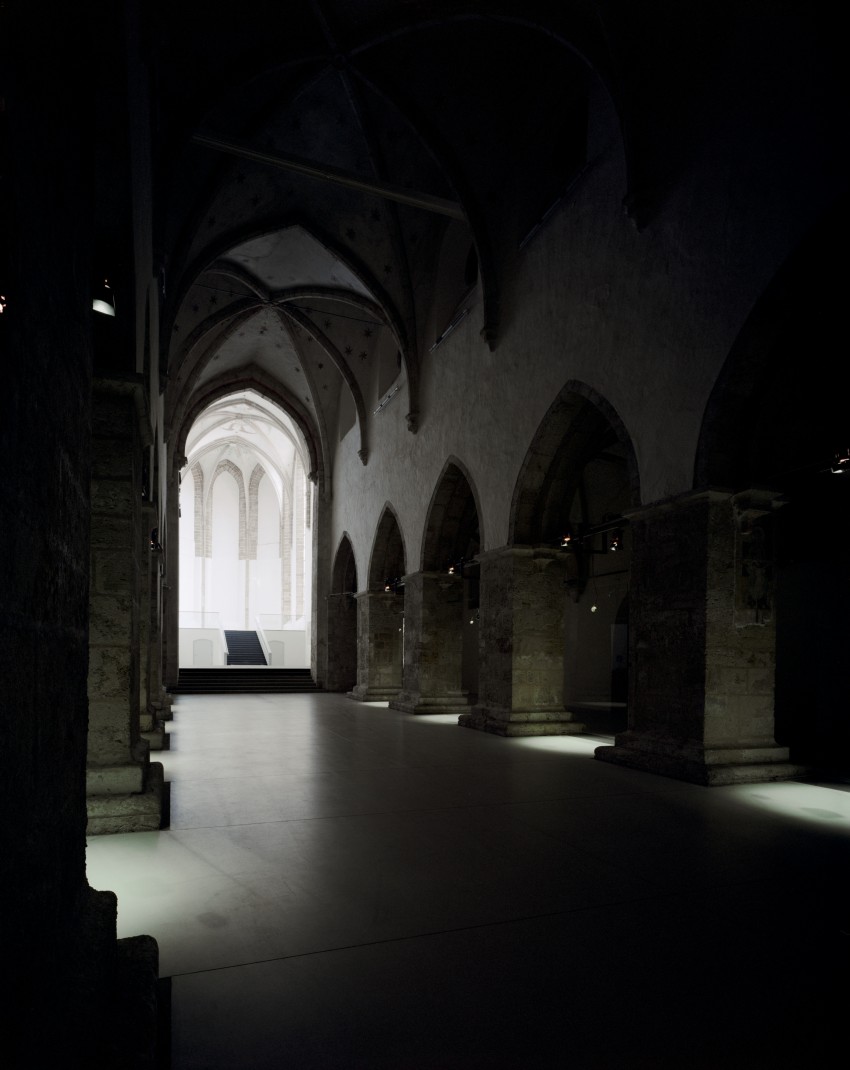
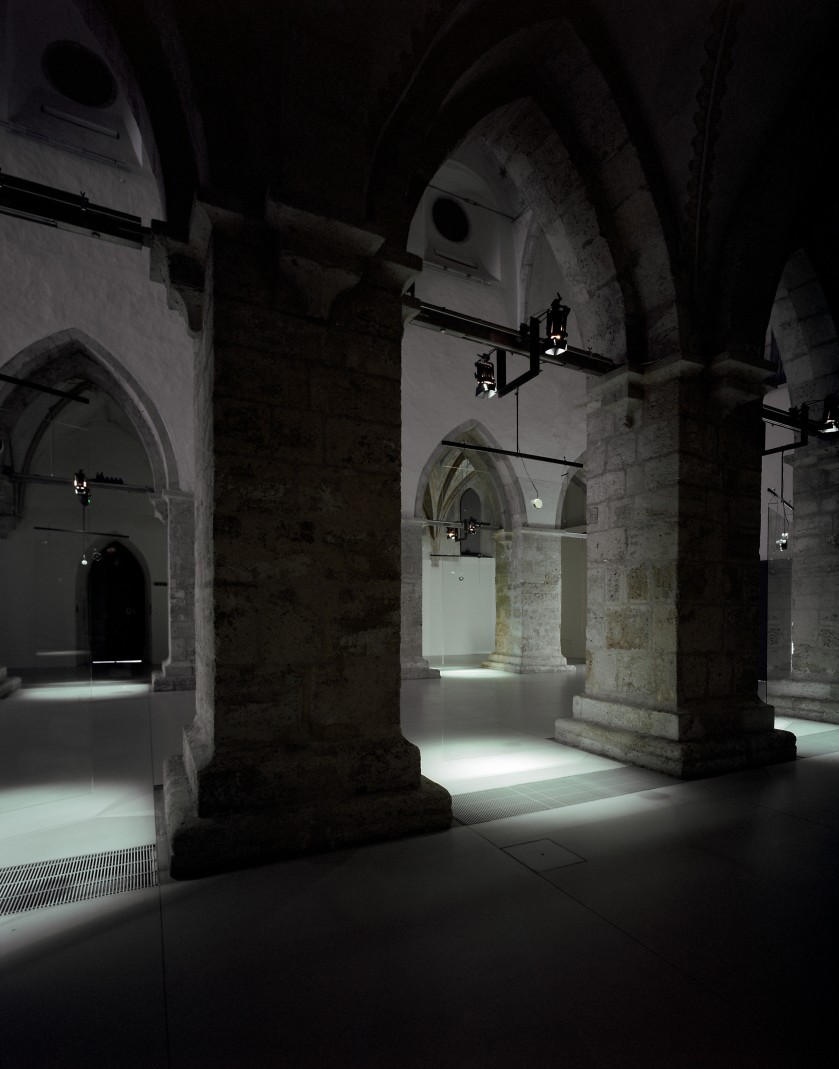
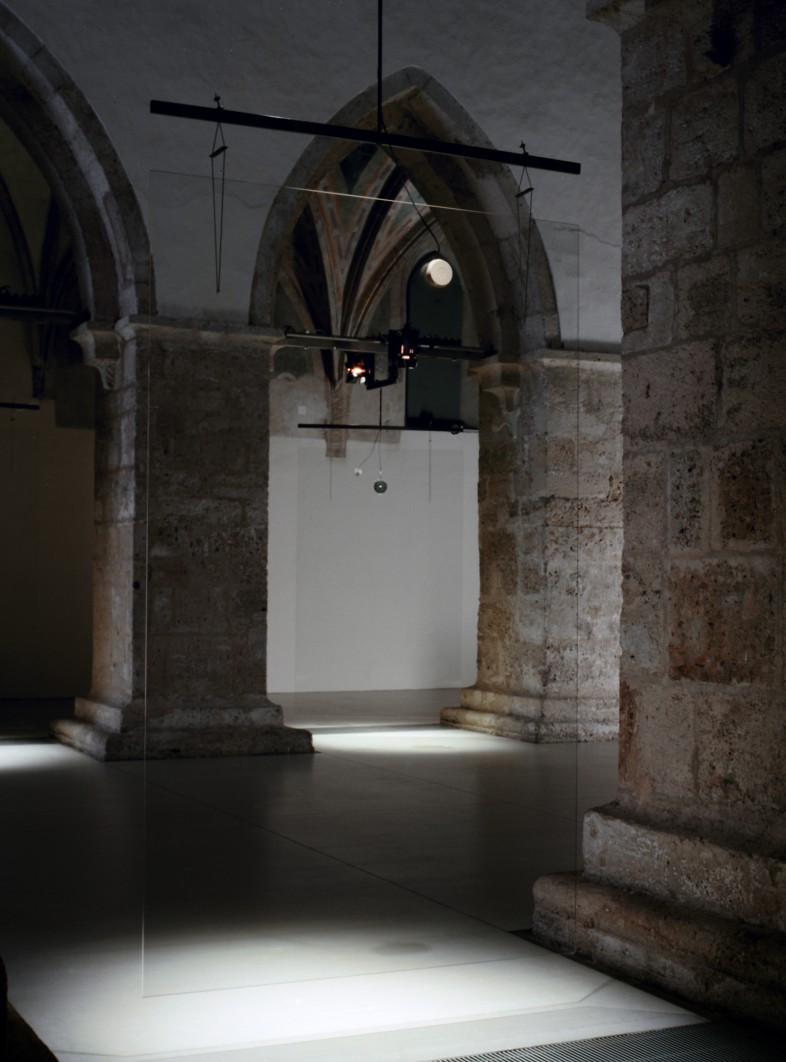
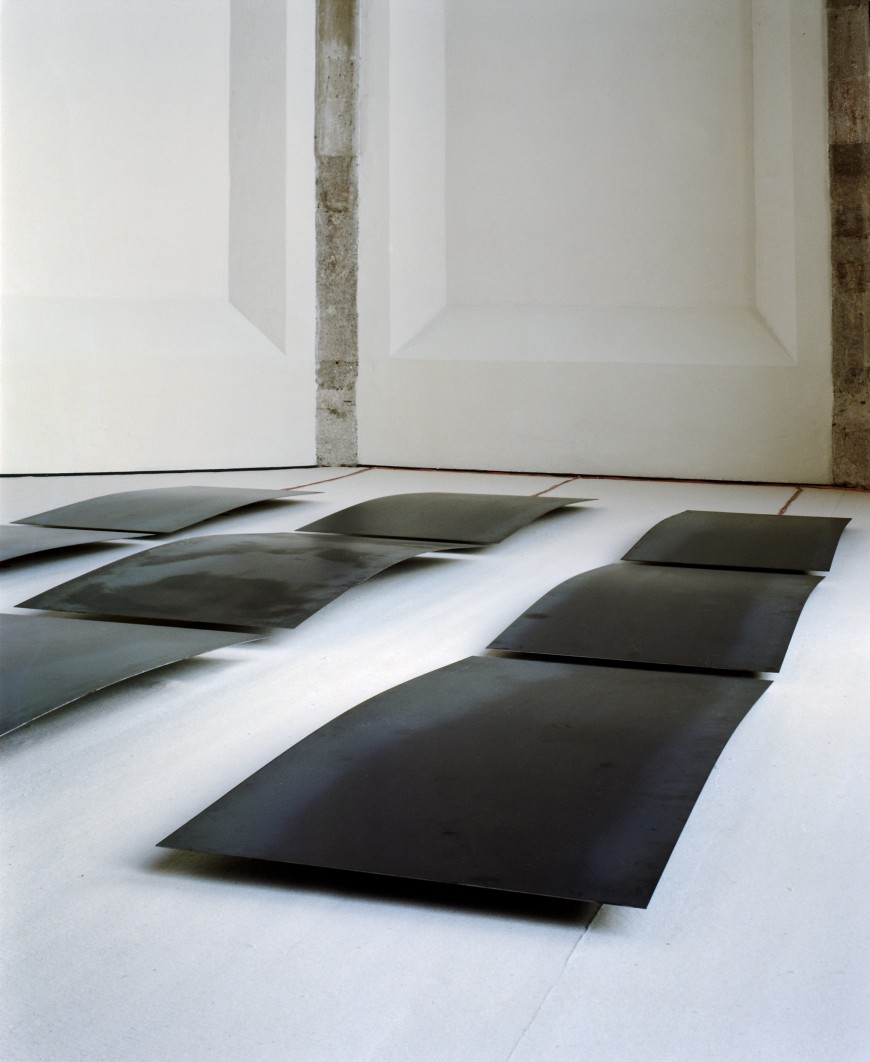
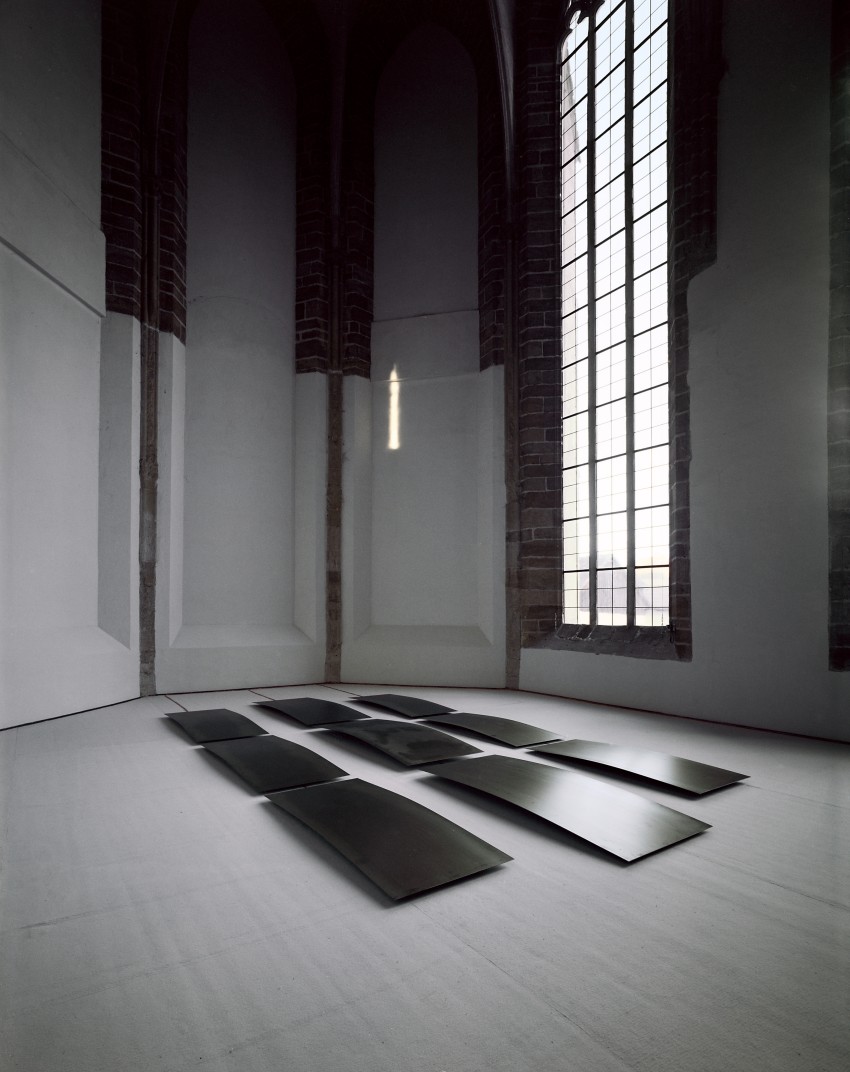
Antiphon Stein is a site-specific sound installation in the nave and choir of Minoritenkirche in Krems / Stein that engages with the architecture and sound of this church space. The material used are hanging and lying flat objects of glass and metal that are played with sound pressure transducers. These objects thus become membranes that resonate in their entire surface and mass, exuding sound to the surrounding space. The initial sounds for the installation are largely generated using a special four-channel recording technique; after the digital editing, they are left in their special four-channel arrangement, since capturing the sound from various spatial perspectives and distances [Raumperspektiven und Distanzen] allows an acoustic image of the existing space to emerge. The sound of the specific space thus plays a central role in the overall acoustic image. By way of the stringency of the early Gothic architecture, the placement or hanging of the surface objects leads to the bipartite, responsorial form of the work. Below in the nave, the eight glass plate objects, each hanging between the powerful columns, above in the former choir the tripartite metal work, arranged on the floor on white felt [Weißer Filz], thus not visible, but only audible from below. The intimacy of the apse with its triptych of metal objects contrasts with the expansiveness of the nave, with the glass surfaces hanging at a great distance. The light design, from the dark nave to the apse flooded in light, seeks to continue this dialogue. The sounds, small compositional miniatures of a duration of three to seven minutes – above more organ, below more cymbal sounds, percussion, resonant glass – are combined by the computer on the basis of a precise score [Ablaufpartitur] into ever new constellations: aleatory in part, sometimes in fixed series and interrupted by interludes that represent in temporal intervals of thirty minutes the only moment in which an individual sound file can access all surface objects in both spaces. The algorithmic components of the composition make possible constant alteration of the various musical textures by way of their differing sequence and overlap of musical cells. This results in a sound-space continuum that regenerates itself over and over that oscillates in timbre. In this way, the sound installation becomes an organism that reinvents itself over and over through the entire duration of the exhibition. The interplay of the two optically divided spaces in various antiphonic ways – the sound that seems to come from above or below and is projected by the architectural features of the location, sound that really seems to float in the ribbed vault – makes a decisive part of the charm of this work. By combining existing architecture and an intervention that is both a played and sounding object, the distinction between visual and sound design is suspended, resulting in a unity of space, materiality, and sound. (Michael Moser)
In his book Atmosphäre (Atmosphere), Gernot Böhme sketches the outlines of a new aesthetic theory that he derives from subjective sensations of our surroundings. Based on synaesthesia, he assumes that perception begins generally, with all of our senses. A foundational object of perception, for Böhme, is the atmosphere. The way in which a subject perceives the ensemble of certain things like light, color, temperature, form, quality of material etc. at a certain time in a certain place creates a certain atmosphere. Conversely, we could say that atmospheres “are the ways in which things and environments manifest themselves.” Architecture in particular, Böhme argues, produces atmospheres in all its creations. For a long time it served to “give the buildings of the rulers the atmosphere of power. As an ecclesiastical art, it created the atmosphere of the sacred in ecclesiastical spaces. (Hannah Schwegler)
The older church nave with two narrow side aisles forms one space, while the divided choir, raised at the rear, forms another. A unique architecture of the Minoritenkirche Krems/Stein: the presbytery is shifted from the middle axis, and in so doing the homogenous spatial effect typical of church architecture is suspended and the two parts of the building seem separate from one another, visually and acoustically. (Nik Hummer)
In architecture, the same proportions of composition have been used as those in music for centuries (1:2, 2:3, 3:4, 4:5, octave, fourth, fifth, third). This coupling of architecture (here as sound space) [Klangraum] and music (atmosphere space) becomes clear in sacred buildings like the Minoritenkirche in Krems/Stein. Every architectural space is also a resonance space for its users, or, to put it more simply, almost every space is an instrument body that can have an astonishing impact when played adequately. (Nik Hummer)
Panels with tactile transducers to transfer sound possess [Körperschallwandler als Klangüberträger] the qualities of a surface that emits non-point like sounds: the thin, bodiless panels produce voluminous corporeal fields of sound. The glass and metal panels [Glas- und Metallplatten als Resonanzkörper] used thus become resonance bodies that deliver the sound, filtered through the material, differently to the resonance space. (Nik Hummer)
Composed musical figures using the material of previously recorded instruments engage with the acoustic particularities offered by the transfer of the sounds via panels. The panels thus operate as loudspeaker membranes with complex filter qualities that modify the natural sound timbres of the instruments recorded (organ, glass, and percussion) by modifying their sound by playing it through the materials of metal and glass. In addition, certain frequencies of the transferred sound material trigger the frequencies and overtones of the plates themselves and initiate additional sounds that mix into the overall acoustic events. (Hannah Schwegler)
Spatially opposite one another, the metal and glass objects in the choir and nave of the church, arranged in geometric figures, serve as stand-ins of two instrumental groups that sound against one another and cover the space acoustically [Akustische Raumüberlagerung]. The arrangement of the sound material for the panels or panel groups [Plattengruppen] and their collection and temporal distribution take place using a complex computer algorithm. By way of chance, individual passages are selected from a total of 24 brief sound sequences [Klangsequenzen] and distributed over a four-channel system on the glass and metal panels. As a rule, the score allowed for two or a maximum of three voices and/or sequences. As in Gregorian chant, where a psalm verse is followed by an antiphon as a refrain-like passage, the sound events in Antiphon Stein are interrupted each half-hour by an interlude. (Hannah Schwegler)